HAXSS: Hierarchical Reinforcement Learning for XSS Payload Generation
Training context-aware agents that craft smarter payloads than traditional scanners
HAXSS: Hierarchical Reinforcement Learning for XSS Payload Generation
Cross-site scripting (XSS) is a client-side code-injection attack. It happens when an application fails to properly process user input, allowing an attacker to inject malicious code that later executes inside other users' browsers.
How an XSS attack works
- Injection: The attacker finds a vulnerable point in the page and injects a malicious payload.
- Trusted payload: The vulnerable site treats the payload as harmless and embeds it into the HTML response.
- Execution: When another user loads the page, the browser executes the injected script.
- Exploitation: The attacker can now steal session cookies, capture keystrokes, perform user actions, or run phishing flows.
Types of XSS
- Reflected XSS: Payload is delivered via a single HTTP request/response cycle without being stored server-side.
- Stored XSS: Payload is saved on the server (for example, in a database) and delivered to many users—making it the most damaging type.
- DOM-Based XSS: The payload stays on the client; the DOM is modified so the script never touches the server.
Traditional techniques
- Sanitisation and encoding: Inputs are filtered or transformed (e.g., stripping ) and treated strictly as data.
1<script> - Black-box scanners: Large payload libraries are fuzzed or mutated to bypass basic filters.
Limitations include low payload diversity, false positives, and poor content awareness.
Enter HAXSS: Hierarchical RL for XSS
HAXSS proposes a proactive, reinforcement-learning-powered scanner. Two specialised RL agents learn to exploit a vulnerable app.
Definitions in this setup:
- Agent: The payload generator.
- Environment: The vulnerable application.
- Action: Adding the next character/string/mutation to the payload.
- Reward: Points for bypassing filters, injecting a script, or executing code.
The hierarchy addresses traditional limitations:
- Context awareness (Level 1 Agent): Analyses HTML structure and crafts structural payloads to break out of the current context.
- Obfuscation (Level 2 Agent): Learns sanitiser bypasses by observing which payloads succeed, discovering complex obfuscation tricks.
System overview
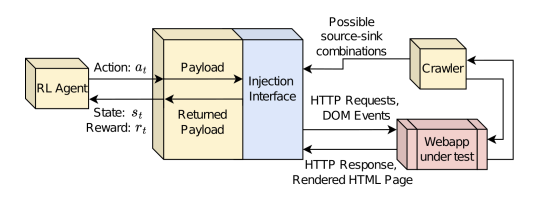
The diagram above shows how the agent interacts with the web app to generate and test payloads.
RL Agent
- At each time step , the agent selects an action (next character, string, or mutation function).
- It receives a state from the environment that summarises the app's response.
- The reward reflects success signals (escaping context, executing scripts, etc.).
Injection interface
Acts as a bridge between the agent and the app.
- Receives: Payload under construction.
- Sends: HTTP requests or DOM events to the target app.
- Receives: HTTP responses plus rendered HTML.
- Feedback: Extracts payload echoes and state signals to feed back to the agent.
Web app under test (environment)
- Accepts payloads via HTTP or DOM events.
- Applies sanitisation logic.
- Returns HTTP responses and rendered pages.
Crawler
Discovers context to support the hierarchy.
- Crawls the app to find inputs (sources) and outputs (sinks).
- Produces source–sink combinations where input can flow to output.
Results
Table I evaluates scanners on the XP Test Bed (10 known XSS vulnerabilities).
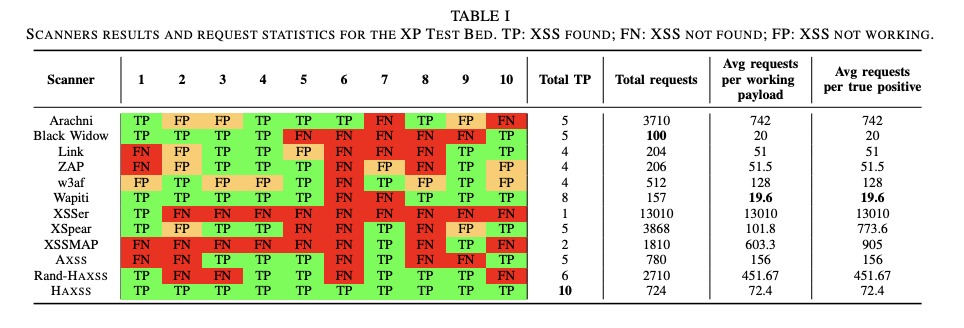
Key takeaways:
- Perfection and accuracy: HAXSS finds all 10 vulnerabilities with zero false negatives.
- Efficiency: Needs only 724 requests for a perfect score, far fewer than scanners such as XSSer (13,010) or Arachni (3,710).
Table II compares scanners on richer, real-world apps.
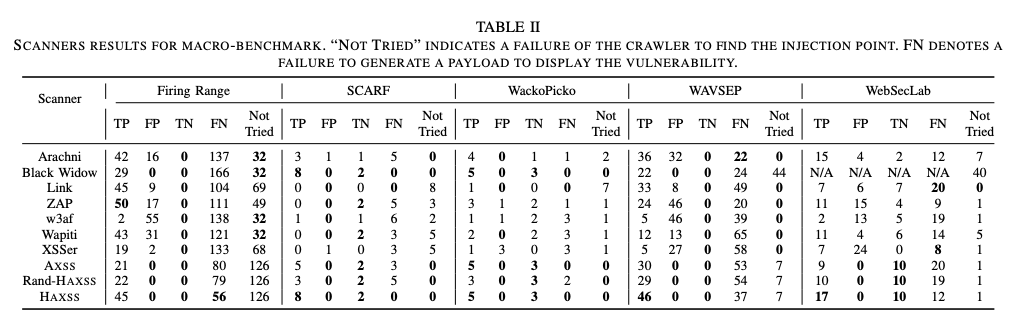
Highlights:
- Zero false positives: HAXSS reports 0 FPs across all targets.
- 45 true positives: Highest TP count while maintaining reliability.
Bottom line: Hierarchical RL delivers context-aware payload generation with superior accuracy and competitive efficiency, making HAXSS a powerful evolution of traditional XSS scanners.